
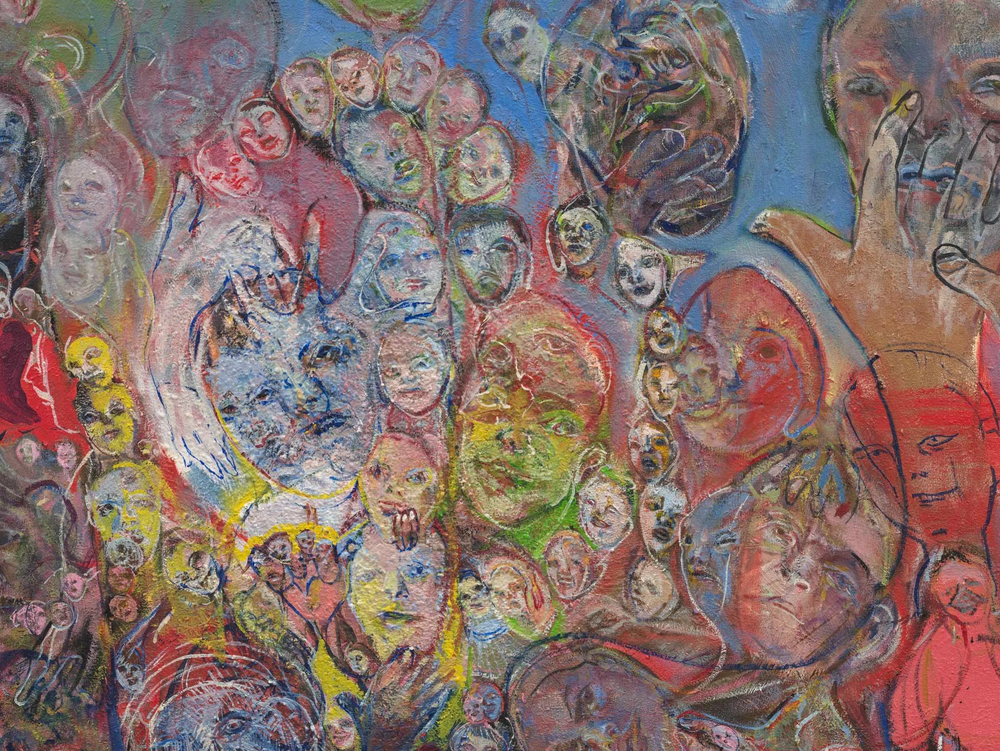
Not long ago, the popular image of the artist included an almost pathological need to keep painting—an inner, psychological compulsion to fill every available surface with urgent marks. Today, in our tragically over-professionalized art world, young artists are often trained to calculate each work with surgical precision, leaving little room for joyful improvisation. Encountering a painter like Judy Glantzman, now based in Chatham, feels an affirmation that painting driven by instinct, devotion, and method evinces a faith in the act itself. In “Playing with Dolls” (February 6-March 14) at P·P·O·W in Tribeca, we get to share that faith.
When Glantzman’s longtime dealer Betty Cunningham retired in 2024 and returned earlier paintings to her, the artist did not archive them as relics. She unwrapped them and decided she could improve them. The result is a group of works dated 2003–2025 in which old and new paint strokes are so thoroughly interwoven that it is impossible to tell where one era ends and another begins. Few works, it turns out, are ever truly finished until they leave her studio. This is not indecision, but a deeply held belief that painting is a way of making the world more manageable—and perhaps more humane.
Glantzman first emerged at the height of the East Village gallery boom, a moment that produced artists such as Keith Haring, David Wojnarowicz, Duncan Hannah, Luis Frangella, Walter Robinson, Jean-Michel Basquiat, and Martin Wong. Her early galleries—Civilian Warfare, Hal Bromm, and Gracie Mansion—still evoke a period when nightclubs, punk venues, leather bars, and DIY art spaces felt inseparable, when it was normal to go straight from an opening into a mosh pit.
Many survivors of that much-mythologized era now make their mature work in the Hudson Valley, including Stephen Lack, Roberto Juarez, and Richard Bosman. Like them, Glantzman’s early years were not marked by timidity or restraint. It was an overwhelmingly masculine testosterone-laced art world even if half the men were gay and only a handful of women—among them Betty Tompkins, Keiko Bonk, and Marilyn Minter—were exhibiting work that insisted on a female-centered erotic figuration. From the beginning, Glantzman filled her canvases with images of a mythic feminine presence: little girls with bows, austere goddesses, and faces that multiply into chains of masks linked together like daisies.
Even longtime admirers will find this exhibition revelatory. Focusing on rarely seen large-scale works from roughly 2000 to the present, it foregrounds paintings that are visually inexhaustible: undulating fields of semi-androgynous faces, like an imagined populace seen from above. These figures are neither portraits of specific individuals nor generic humans. Each face, viewed in isolation, becomes a compelling presence, tempting the viewer to search for recognition or resemblance. Yet the overall effect resists organization; try as one might to focus on a single figure, others continually call for attention.
Glantzman admits that, during the process, a missing friend may suddenly appear. “David,” she says—meaning Wojnarowicz—“keeps making himself visible.” In many works, one or two heads loom larger than the surrounding field, echoing the way attention on a crowded train can suddenly telescope toward one stranger whose face demands contemplation.
When the Rubell Museum in Miami mounted an exhibition examining the period in the early 80s when the legendary collection of Don and Mera Rubell first took shape, Glantzman’s work was shown alongside that of Lack, Frangella, and Rick Prol. Her paintings appeared gentler and more rhapsodic than those of her male peers, offering an alternative emotional register within the same historical moment.
Glantzman’s work has never been content to remain on the wall. She moved into three dimensions early on, painting portraits of friends, collectors, and her dealers on shaped plywood panels installed with bases. Ceramics followed naturally: hand-built heads and torsos, small in scale, with exaggerated yet childlike expressions of wonder. Working near her home at Ugly Mud Studio in Ghent, she produced innumerable variations, each one unique and visibly shaped by the pressure of her fingers. For this exhibition, they are installed as they are in her studio, clustered together in a quietly magical congregation.
Glantzman moved to Chatham in 2008 with her partner, cartoonist, animator, and musician Gary Lieb, who passed away in 2021. Living in what she readily acknowledges as a natural paradise has not dulled her punk edge. Approaching 70, she remains deeply engaged with students—often now via Zoom—and is an enviable role model: fully conversant with contemporary cultural issues, yet carrying a profound knowledge of art history. In her studio, the ghosts of Rembrandt, Ensor, and de Kooning linger like spirited companions.
Across four decades, Glantzman has sustained a career both in and out of the spotlight with unusual generosity. Her work reminds us what a life in art can promise true believers—devotion, and faith in the ongoing possibility of crafting haunting visions of how we can ecstatically share the planet with our fellow beings.