
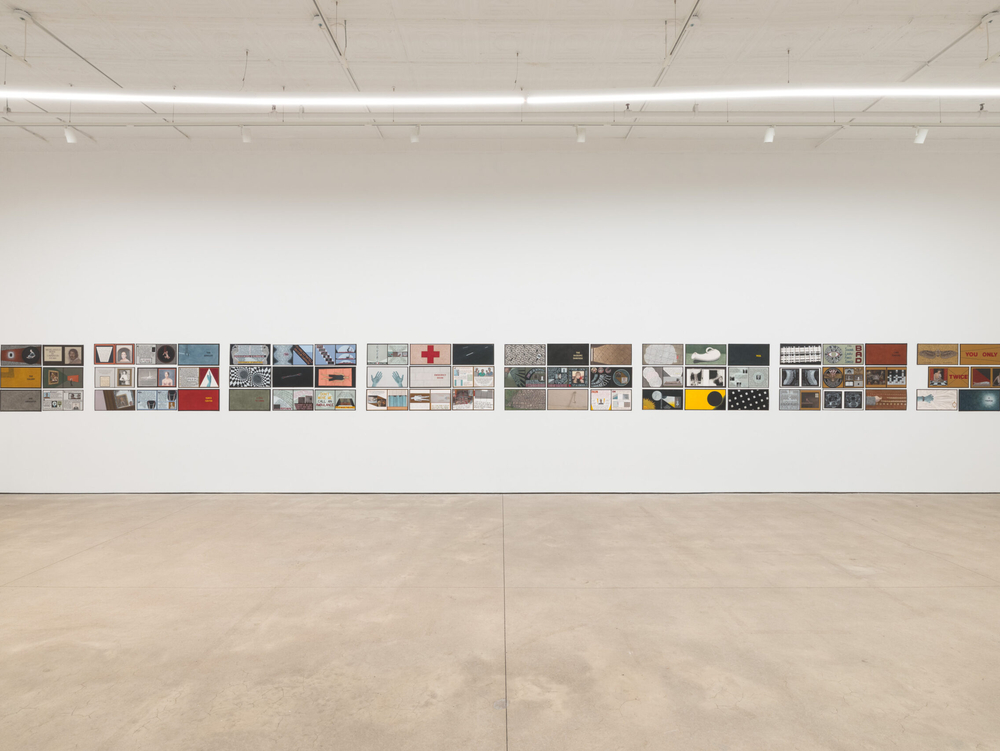
A FRIEND GAVE ME A BOOK, John Kelly’s first exhibition with P·P·O·W, marks a profound shift in the artist’s career. Centred on Kelly’s 182-panel, hand-illustrated graphic memoir and a video work that echoes and refracts it, the show poses a singular, urgent question: what happens when a practice built on disappearing insists on staying put?
For over four decades, Kelly—a New York–based performance and visual artist—has worked from one conviction: the self is not a stable subject but a role—rehearsed, borrowed, risked. He has treated his body as a medium of return, inhabiting figures like Antonin Artaud, Egon Schiele, Joni Mitchell, and Barbette, the 1920s aerialist and drag artist, as temporary homes. Yet this was never mere impersonation. Kelly uses these figures as thresholds where biography, desire, and art history converge and complicate one another. As he notes, “varying degrees of autobiography have permeated these works; performance as self-portrait.”
Now, that ephemeral circuit has solidified into a tangible archive. The show’s title evokes a small scene of transmission—a friend pressing a book into the artist’s, or even perhaps your, hands—but it also names a precarity: how does queer cultural memory survive when it has historically depended on liveness and the fragile continuity of those still alive to remember? For queer artists of Kelly’s generation, the question of form is never only aesthetic; survival pressures memory to become legible, transmissible, harder to erase. Kelly’s practice has long embraced ephemerality—the live moment, the unrepeatable gesture—but survival itself has made disappearance feel untenable. What once served as a mode of freedom now risks becoming a form of erasure.
Catastrophe serves as the hinge for this transition. In 2004, while preparing a work inspired by his obsession with Caravaggio, Kelly incorporated trapeze as a dramatic element, and fell, breaking his neck. Created between 2016 and 2025—more than a decade after the accident and with the distance survival demands—the graphic memoir braids Kelly’s retelling of that fall with poetry rather than resolving it into a lesson. But the fall is only one layer of trauma. Kelly marks his HIV diagnosis in 1989, a date he speaks of with the plainness of a companion he has lived beside for decades. On some level, his work has served as a form of bearing witness, processing his relationship to the epidemic, not as slogan or testament, but as form: a record-making practice that refuses to let loss remain uncounted. In this context, the memoir does not ask us to admire endurance; it asks what endurance does to form. Kelly’s answer is to compose in layers—interior monologue beside art-historical citation, lyric fragments beside blunt witness.
Installed across the gallery walls, the memoir turns the space into a book. You encounter it first as a field, panel after panel, before it resolves into sequence, forcing you into a choreography of reading: you do not merely “take in” the story; you move through it, body by body. The visual language is restless, shifting from Roman stone walls and cypress trees to the violent chiaroscuro of Caravaggio, interspersed with vertiginous symbols evoking psychedelic experience and the disorientation of trauma. Then, the body arrives as fact—the narrative moves from the disciplined grace of the aerialist to the sudden stillness of the hospital gurney, the performing self replaced by anatomical diagrams and stark MRI scans.
If the East Village taught a generation that ephemerality was power—cheap, fast, unmarketable, and therefore hard to police—the AIDS crisis revealed its cruelty. A community’s memory cannot survive on liveness alone when that community is being decimated. As art historian David J. Getsy has observed, queer life in the 1960s found significant representation in literature, film, and performance, yet “the privileged arenas of the gallery, the art collection, and the museum kept themselves walled off from the places and people of queer life.”2 Getsy’s longer history clarifies that this institutional distance predates the epidemic; AIDS simply made its consequences devastating. For decades, queer memory survived primarily through ephemeral forms—celebrated for their elusiveness, yet vulnerable to loss.
Kelly’s memoir thus represents not only personal reckoning but formal negotiation: the translation of lived experience into an object that can circulate within institutional spaces that have not always made room for it. This is why A FRIEND GAVE ME A BOOK functions less as a traditional memorial than as a living archive. It does not offer the closure that traditional memorials promise but something closer to what Kelly’s time-based practice has always understood: that memory lives in duration, in the unfolding encounter between body and witness.
The translation carries its own risks—objects move differently than performances, accumulating context as they circulate—but Kelly builds the work as friction rather than consolation, insisting on sequence without offering cure. The quiet provocation is that Kelly has constructed a form sturdy enough to hold the fragility of memory without pretending to repair it. A friend gives you a book; you carry it; you pass it on. In Kelly’s hands, that gesture becomes an ethics: to remember with enough precision—and enough formal ambition—that the vanished are not erased twice.