
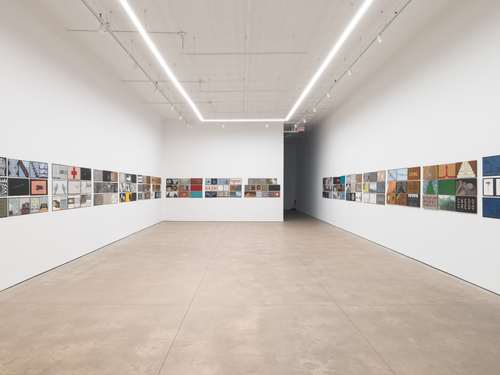
In 2004, rehearsing a trapeze performance elaborating his preoccupation with Caravaggio, John Kelly fell and broke his neck. He spent 15 hours in the hospital and a year recovering. The monumental graphic memoir A FRIEND GAVE ME A BOOK (2016-2025), currently on display at P·P·O·W, grew from this experience. Its panels are presented running in an eye-level frieze around the entirety of the main gallery. In the rear gallery, we find the film (2011–2025) from which A FRIEND GAVE ME A BOOK emerged. It goes by the same title and is scored by Kelly himself from his appropriately named album Beauty Kills Me (2016).
Performance happens in the moment. It connects us to time in the manner that life is lived, always in the present. This is perhaps best experienced in the medium of music in which the performer remakes our feelings even as we listen. In visual art, performance is the natural extension of the Italian Renaissance ideal that sculpture should actually live and not merely emulate life. Performance takes that statement at face value and turns the tables: rather than asking sculpture to live, it asks the artist to live life as art.
In considering Kelly’s visual art, with its mash up of autobiographical and poetic text with figurative imagery imposed upon by various abstract patterns of graphic emphasis, it is helpful to keep in mind that, by all appearances, Kelly is a performer first. He was a student of the American Ballet Theatre School and has spent his career on stage imaginatively inhabiting the creative personas of performers as diverse as Antonin Artaud and Joni Mitchell, with a special place for visual artists, such as Egon Schiele and, of course, Caravaggio (in his performance The Escape Artist, 2011), whose lives were short and hard.
The organizing principle behind Kelly’s graphic work is furnished by the lived narratives it describes, a prolonged meditation on the mysteriousness of individual experience. The brooding palette of blacks, whites, ochres, and reds in the first panels of the frieze connect us to the shadowy life of the painter preoccupying Kelly. Vibrant Prismacolor pencilwork springs from a pivotal moment in his recovery. Tantalizing phrases such as, “Blessing or Curse / Which is worse / Some feed the soul / And some the purse,” were lyrics for a song before they ever made it into the graphic work. We learn that almost all the imagery in the graphic work emerged from stills and lyrics in the film, suggesting that, for Kelly, drawing and painting are ways of concretizing ephemeral feelings or bodily states first transcribed in movement and song.
This helps explain the elegiac quality of Kelly’s visual art, which honors otherwise ignored moments of obsession, passion, fear, trauma, and loss by recording them. It also points to a deeper dimension of Kelly’s work that I would describe as religious. In Kelly’s film, floating on the gentle strains of his music, we are led through an analogy between the artist’s body—post fall, immobilized in traction—with haunting stills of that same body used as amedium, miming the implied action of a Caravaggio, fully costumed and lit. Kelly exploits the sense of continuous action that Caravaggio ably evoked in paintings to heighten the sense of constraint we feel looking at his prone body. Christian doctrine insists that the human spirit is similarly caught in the material casement of the body, the drama of which predicament underlies a great deal of Western Art.
“YOU ARE DEFINITELY ON YOUR OWN NOW,” reads lurid orange text in one diptych describing the moment of Kelly’s injury in A FRIEND GAVE ME A BOOK. Kelly’s survival story might furnish material for a broader tale of those marginalized communities unwilling or unable to conform to society’s limited behavioral norms. But that feels counter to the artist’s focus. Kelly’s survivor, as described in A FRIEND GAVE ME A BOOK, is not entirely isolated. On the contrary, he is open and receptive to fellowship and contact, poetry and love. And he receives it. If he is misanthropic, then he is so more by eccentricity and exceptional vision than by heterodox behavior.
The transformation of trauma into transcendence is an old game in art. What makes Kelly’s contribution noteworthy is the depth of feeling underlying it. The caged bird sings for a reason. I surmise that Kelly sees in Caravaggio an artist whose painting was worthy of his suffering, whose sacrifice redeemed his self-indulgence. Kelly may have found in his own anguish a fulfillment of Caravaggio’s promise for him and is thus able to offer a reminder that the occurrences of our everyday lives are always far more profound than we may realize. They are, in fact, the substance of art.