
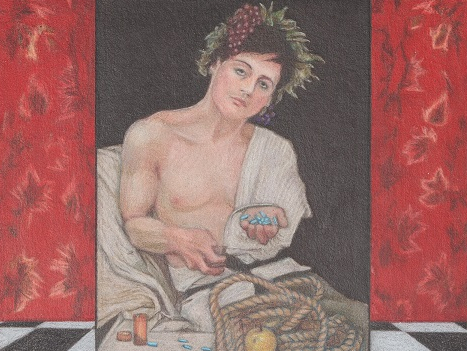
Why a book? This is the question that was on my mind as I slowly circumambulated the main gallery at P·P·O·W, where John Kelly’s 182-panel, hand-illustrated graphic memoir A FRIEND GAVE ME A BOOK, 2016-2025, is on view through February 21. It tells the tale of a catastrophic trapeze accident that resulted in 15 hours at the hospital and a year of recovery, not to mention all manner of philosophical and artistic revelations. Kelly is best known as a performer of uncanny imitations, invoking the likes of Joni Mitchell and Egon Schiele in shows that combine musical performance, theater, drag, and dance. This memoir, then, which is so avowedly autobiographical and so fixedly visual—far surpassing the scale and impact of the self-portraiture he showed back in 2009—comes as somewhat of a surprise. Moving from one panel of it to the next, I wanted to know what specific aspects of the codex appealed to Kelly in contrast to the many other mediums in which he has worked; I wanted to know why this story required this form.
When I sat down with Kelly to discuss his theories of medium, his first impulse was to dodge the opportunity for theoretical postulation in favor of anecdotal matter-of-factness: “The whole rigamarole began with a friend giving me a book of Caravaggio’s paintings,” he said, “and I decided to invent a character like him, a contemporary artist, but the performance never got done because I broke my neck.” True though this is, it only obliquely offers insight to what the form of a book allowed Kelly to achieve. After all, the accident occurred in 2004, and it was not for several years after then that he began to translate the experience into a book. For a while, it existed as a short story, never published. Then, he turned it into a live performance with a three-channel video component which is projected in the back gallery at P·P·O·W. In the end, it was from the storyboards for the video that the book grew. So the answer as to why a book is more complicated than the mere fact that injury foreclosed performance, or that it started with a book so must end with one too. As I came to understand, obliquity and digression are in fact key aesthetic tactics for Kelly. Indeed, especially in the graphic memoir, this narrative of quite brief temporal range, from fall to patient discharge, becomes an extensive text replete with tangents and interruptions.
The linearity of the story is, then, quite fragile—much like the body. As Kelly put it, the story is “fleshed out,” and he imagines it bound in a book with a spine that can break, just as his did. There is a panel that appears at the point in the narrative when Kelly is being embedded in an MRI machine to determine whether or not he will need surgery, reading,
“MRI · SEE WHAT’S INSIDE THE VOLUME OF FLESH AND BONE · LIGHT AND DARK TOGETHER · IN THE SAME BODY · UNDER THE SAME SKIN · CHIAROSCURO · ITALIAN FOR LIGHT AND DARK TO CREATE THE ILLUSION OF VOLUME.”
So much hinges on the word volume here. As Kelly explained, “That’s the deliberate joining of my reality with the reality I was pondering and working on at the time, that of Caravaggio.” Even if the one artist relies on the technique of chiaroscuro, while the other uses magnetic resonance, they are both united by image-making practices geared toward producing the illusion of volume. In another sense, however, volume implies a book filled by the kind of life in which artistic production and bodily fragility, light and dark, triumph and tragedy, all interpenetrate. In this way, there is here a theory of the text itself, a theory of the book as a living volume, a fleshy body.
Kelly brought my attention to another panel whic h appears later in the narrative, around the twelfth hour in the hospital, when his protagonist ponders the shore on which Caravaggio supposedly died. This is one of the many interruptions to the enunciation of the narrative, for there is no text here—only the image of a beach with grassy dune in the foreground, sparkling water and sky beyond. However, this placid scene is interrupted in its own right by a wound to the picture surface: two thin gashes at the bottom center open the page like skin, revealing a sparkling red layer beneath, an effect à la Lucio Fontana or Adriana Varejão. “I’m sure Caravaggio would have appreciated glitter,” Kelly quipped. “Normally, a beach feels like a place of refuge, but I had to screw it up, because that’s what happened to him—syphilis, malaria, or whatever. There can still be beauty at the nadir.” These two injuries to the very image itself are moments of uncertainty and openness in the book, as if the story were inviting the imposition of meaning, inviting various interpretations and added weight from reader to reader, context to context.
Carrying this idea further, Kelly tells me that, “The book doesn’t really close. It ends with a question about the life of the artist—why do we do it?—and at the very end, people are like, Oh, fine. But it's fine, which means end in Italian.” Just like the slashed beach scene, the end of the book hangs open. There is no definite termination of the narrative, but an acceptance of the fact that, as the fourth-to-last panel declares, “WHAT’S HARD STAYS HARD.” In other words, keep on living, keep on experiencing difficult and also erotic situations; the story is ongoing, resolved never to resolve. Kelly does not only convey these ideas semiotically, but performatively—by letting the book itself behave like a body that can be opened and penetrated.